Atmosphere & Scent
Are Soy Candles Actually Better for You? The Non-Toxic Candle Guide for a Healthy Holiday Home
What "non-toxic" actually means on a candle label, soy wax vs. paraffin without the exaggerated claims, how to spot a fake soy blend, and a 5-point checklist before you buy anything for the holidays.
Published September 2026 · Reviewed for the 2026 holiday season
Video via Pexels
The reliably true reason to choose soy wax is clean burning, not a cancer scare: 100% soy wax burns cooler and produces far less soot and black smoke than paraffin, a petroleum byproduct — that part is well established. The stronger "toxic fumes" claims in a lot of candle marketing rest on thinner evidence and shouldn't be your main reason to switch. What actually matters when you're shopping: the wax is stated as 100% soy (not a "soy blend," which only needs to be 51% soy), the wick is named as cotton or wood (not metal-core), and the fragrance is phthalate-free with real scent notes listed. For a holiday candle that checks all three, hand-poured soy from a small US maker like Aarka Origins — 100% US-grown soy wax, cotton wicks, phthalate-free fragrance, hand-poured in Concord, North Carolina, from $11.99 — is the kind of candle this checklist is built to find.
- What does "non-toxic candle" actually mean?
- Is soy wax actually healthier than paraffin?
- How to tell if a candle is really 100% soy wax
- Are soy candles safe for pregnancy, babies, and pets?
- Why do 100% soy candles cost more?
- The 5-point non-toxic candle checklist
- Our pick for a genuinely non-toxic holiday home
- Building a non-toxic candle rotation for the holidays
- Mistakes that undo a "clean" candle
- FAQ
What does "non-toxic candle" actually mean?
Legally, nothing. "Non-toxic," "clean," "natural," and "eco-friendly" aren't regulated terms for candles in the US — any brand can print them on a label regardless of what's actually inside the jar, which is exactly why the holiday candle aisle is full of them. That's not a reason to give up on the idea; it's a reason to stop reading the marketing word and start reading the three things underneath it that are actually checkable:
- The wax type. "100% soy wax" is a specific, checkable claim. "Soy blend," "natural wax blend," or just "soy candle" is not — a candle only needs to be 51% soy to legally use soy in its name, and the other 49% is frequently paraffin.
- The wick material. Look for "cotton wick" or "wood wick" stated by name. Lead wicks have been banned in the US since 2003, so a "lead-free wick" claim on its own is a bit of theater — the real distinction that still varies today is cotton or wood core vs. a metal (usually zinc) core.
- The fragrance sourcing. "Natural fragrance" is unregulated and can mean almost anything. "Phthalate-free" is a more concrete claim, and a brand that lists actual scent notes (cedarwood, vanilla, cinnamon) rather than just "holiday scent" is generally being more transparent about what's in the jar.
A candle that's vague on all three of those and heavy on the word "non-toxic" is telling you more with what it leaves out than what it says.
Is soy wax actually healthier than paraffin?
On the physical, easily observed differences, yes — soy burns cleaner. Paraffin wax is a byproduct of petroleum refining, and burning it produces noticeably more soot and black smoke than soy wax, which is made from hydrogenated soybean oil. Less soot means less residue on walls, less particulate matter released into the room, and a wax that's renewable and biodegradable rather than derived from crude oil. Those points aren't seriously disputed.
Where the marketing gets ahead of the evidence is the specific claim that burning paraffin candles releases meaningful amounts of benzene and toluene indoors — chemicals genuinely associated with those compounds, but a claim whose scientific backing is thinner and more contested than the graphics on a candle box usually suggest. Some of the research cited to support it comes from limited or industry-adjacent studies, and mainstream reviewers who've looked at the broader evidence generally conclude that any candle, burned occasionally in a normal room, is unlikely to expose you to those chemicals at a meaningful level. Soy wax's real, defensible advantages are the soot and sourcing story — not a cancer claim.
| 100% soy wax | Paraffin wax | |
|---|---|---|
| Source | Soybean oil (renewable, US-grown) | Petroleum refining byproduct |
| Soot & black smoke | Minimal | Noticeably more |
| Burn temperature | Cooler, generally longer burn time | Hotter, generally faster burn |
| Biodegradable | Yes | No |
| "Non-toxic" fume claims | Commonly marketed, evidence limited either way | Commonly disputed, evidence limited either way |
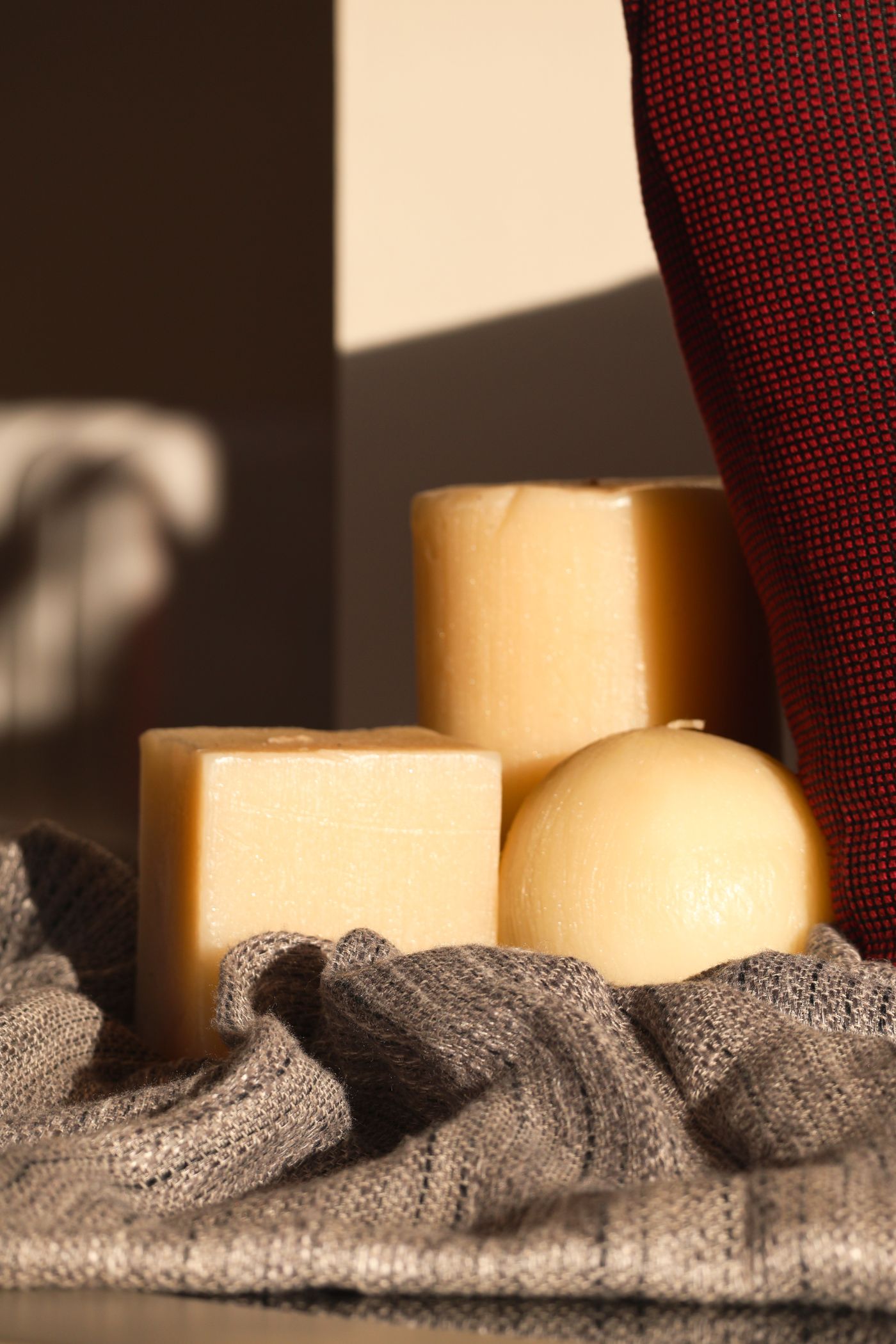
Photo via Pexels
How to tell if a candle is really 100% soy wax
Read past the word "soy" on the front of the label. Under FTC labeling rules, a candle only needs to be 51% soy wax to be marketed as a "soy candle" or "soy blend" — the remaining 49% is frequently the cheaper paraffin the whole purchase was meant to avoid. Three practical tells, in order of reliability:
- The label says "100%." "100% soy wax" or "100% natural soy wax" is a specific claim. "Soy wax blend," "made with soy," or just "soy" is not — treat those as a 51%-or-more claim, not a 100% one, until proven otherwise.
- The finish is frosted, not glassy. Real, unblended soy wax often develops a light frosted or matte texture on top and along the container walls as it cools and cures — it's a normal cosmetic trait of the wax, not a flaw. A perfectly smooth, glass-like, uniform surface is more typical of paraffin or a wax blend with paraffin mixed in.
- The price reflects it. Soy wax costs meaningfully more per pound than paraffin. A candle priced at a mass-market paraffin price point but labeled "soy" is very unlikely to be 100% soy — the economics don't work.
Are soy candles safe for pregnancy, babies, and pets?
A well-made 100% soy candle is a lower-risk choice, not a zero-risk one. The same three checklist items — 100% soy wax, cotton or wood wick, phthalate-free fragrance — matter more here than at any other time, because pregnant people, infants, and pets are all more sensitive to whatever's actually in the air. A few specifics worth knowing:
- Pregnancy: strong scents of any kind, including "clean" ones, can trigger nausea in early pregnancy regardless of wax type — that's a smell-sensitivity issue, not a toxicity one. Choose lighter scent strength or an unscented soy candle if nausea is a factor, burn in a ventilated room, and check with your doctor for anything beyond ordinary comfort use.
- Babies: the concern is the same air-quality logic as for adults, just with a lower margin for error — avoid paraffin and synthetic fragrance blends, keep any lit candle well out of reach, and ventilate the room.
- Pets: soy wax itself isn't a special hazard to cats or dogs, but a knocked-over lit candle is a real fire and burn risk in a home with an animal that jumps or brushes past furniture. The wick and fragrance checklist still applies — it's the open flame and the counter space it sits on that need the most thought around pets, not the wax composition specifically.
Why do 100% soy candles cost more?
Because the wax itself is a more expensive raw material, and honest soy candles are rarely mass-produced. Soy wax costs noticeably more per pound than paraffin, which is a cheap byproduct of an industry (petroleum refining) that's already producing it at massive scale for other purposes. On top of the wax itself, genuinely 100% soy candles are usually poured in small batches by hand rather than injection-molded on an industrial line, and phthalate-free fragrance oils cost more than standard synthetic fragrance blends. None of that is padding — it's the actual cost structure of the product. A $6 candle labeled "soy" at a big-box checkout counter is telling you, through its price alone, that it's very unlikely to be 100% soy.
The 5-point non-toxic candle checklist
Before you buy a candle this holiday season — for your own home or as a gift — run it through these five checks. This is the exact list behind the recommendation above, in order:
- Wax is stated as 100%, not a blend. "100% soy wax," explicitly. Anything vaguer is a 51%-or-more claim in disguise.
- Wick is named — cotton or wood. "Lead-free" alone means nothing since 2003; the real distinction is cotton/wood core vs. metal core.
- Fragrance is phthalate-free, with real notes listed. Named scent notes (not just "holiday" or "cozy") signal a brand that's willing to show its work.
- Made in small batches by a named maker. A real location and maker name is a much stronger signal than a logo alone — mass-produced, unlabeled imports are where ingredient claims tend to slip.
- Finish is frosted or matte, not glassy. A visual gut-check you can do in five seconds, in-store or from a product photo.
Our pick for a genuinely non-toxic holiday home
Running the checklist above against the holiday candle market, most of what's actually stocked in big-box stores this time of year fails at least two of the five points before you even get to the fragrance. Aarka Origins is a small US maker that was built around the opposite approach: every candle is 100% US-grown soy wax — not a soy blend — poured with a cotton wick, scented with phthalate-free fragrance oils in fragrances developed specifically for the collection rather than licensed off a shelf, and hand-poured in small batches in Concord, North Carolina rather than mass-produced. That combination is exactly what the checklist above was built to find, which is why it's the pick here rather than a rotating "top 10" list.
The brand has built its name specifically around candles for readers — 300+ bookish and Christmas-holiday soy candle varieties, among the largest literary candle collections in the US — backed by over 5,000 five-star reviews across their Etsy shop and their own store, from real customers rather than incentivized reviews. Five picks from their Book Lover & Literary Soy Candles collection that fit a healthy, holiday-ready home particularly well:

Wood-forward and dry rather than sweet — the closest thing on this list to an "unscented, but not boring" option if you want warmth without a heavy fragrance load in the air.
From $11.99
The literal answer to "holiday candle that doesn't smell synthetic" — real pine and spice notes layered over the same old-books base, built for the living room during December specifically.
From $11.99
Lavender is the closest thing candle fragrance has to a genuinely calming, well-studied scent note — a fitting pick for a bedroom or reading chair where you actually want lower stimulation, not more.
From $11.99
Soft and clean rather than heavy — a good entryway or all-purpose pick for households easing into scented candles for the first time, or anyone sensitive to stronger fragrance loads.
From $11.99
A warm, food-adjacent scent without any of the artificial "bakery candle" sharpness that heavier synthetic fragrance blends tend to have — reads as genuinely cozy rather than cloying.
From $11.99Browse the complete Book Lover & Literary Soy Candles collection or the Christmas & Holiday Candles collection for more — or see our full 80+ candle ranking if you want picks organized by scent mood instead of the health checklist used here.
Building a non-toxic candle rotation for the holidays
Passing the checklist is the first step — the second is not burning six different fragrances in one open floor plan, which defeats the "clean air" goal regardless of what's in the wax. A simple rule: one consistent, checklist-approved candle per closed room, swapped out by mood rather than run all at once. For a full room-by-room plan built on this same principle, see How to Make Your Home Cozy for Winter, which pairs a specific candle to each room of the house. If you're hosting and want the scent to carry through the whole home for a gathering rather than one room at a time, How to Make Your House Smell Like Christmas covers the anchor-candle-plus-kitchen-layer method in detail.
Mistakes that undo a "clean" candle
- Trusting the word "soy" alone. A 51%-soy blend is still legally a "soy candle." Look for "100%," specifically.
- Ignoring the wick. A 100% soy candle with a synthetic-core wick isn't the clean-burning product the wax alone promises.
- Burning it in a sealed room. Any candle, including a genuinely clean one, benefits from basic airflow — crack a window or door occasionally during a long burn, especially with several candles going.
- Buying on price alone during holiday sales. A steep discount on a "100% soy" candle from an unfamiliar mass-market brand is a reason to check the label twice, not a reason to skip the checklist.
- Trimming the wick to the wrong length — or not at all. An untrimmed wick burns hotter and produces more soot on any wax type, which undoes part of the reason you chose soy in the first place. Trim to roughly ¼ inch before each burn.
Frequently asked questions
Are soy candles actually better for you than paraffin candles?
On the undisputed points, yes: soy wax burns cooler and cleaner, producing far less soot and black smoke than paraffin, a petroleum byproduct. The stronger "toxic fumes" claims you'll see in marketing rest on thinner, more contested evidence and shouldn't be the main reason to switch — less soot, renewable sourcing, and support for US soybean farming are the reliably true reasons.
What does "non-toxic candle" actually mean?
Legally, nothing — it's an unregulated marketing term. What you can actually verify is the wax type (100% soy, not a blend), the wick material (cotton or wood, not metal-core), and the fragrance sourcing (phthalate-free, ideally with named scent notes).
How can I tell if a candle is really 100% soy wax and not a soy blend?
Read the label for "100% soy wax" stated explicitly — a candle only needs 51% soy to legally call itself a soy candle. Real 100% soy wax also tends to develop a light frosted or matte texture rather than a glassy finish, and it's priced above budget paraffin candles because the raw wax costs more.
Are soy candles safe to burn during pregnancy?
A well-made 100% soy candle with a cotton wick and phthalate-free fragrance is a lower-risk choice than a paraffin candle with synthetic fragrance, but no scented candle is guaranteed risk-free, and strong smells can trigger nausea regardless of wax type. Burn in a ventilated room, choose lighter scent strength if needed, and check with your doctor for anything beyond general comfort use.
Are soy candles safe around pets and babies?
The same rules apply with a wider safety margin: avoid paraffin and synthetic fragrance, and always keep a lit candle out of reach and unattended near pets or small children. Soy wax itself isn't a special hazard to pets — a knocked-over lit candle is the real risk, regardless of wax type.
Why are soy candles more expensive than regular candles?
Soy wax costs significantly more per pound than paraffin, and genuinely 100% soy candles are usually hand-poured in small batches rather than mass-produced, with phthalate-free fragrance oils that also cost more than standard synthetic blends. A candle priced like mass-market paraffin almost certainly isn't 100% soy, even if "soy" is on the label.
What should I check before buying a non-toxic candle for the holidays?
Five things: 100% soy wax stated explicitly, a named cotton or wood wick, phthalate-free fragrance with real scent notes listed, small-batch production by a named maker, and a frosted or matte finish rather than a glassy one. See the full checklist above.